


Canadian authorities on Wednesday arrested a 23-year-old Ottawa man on suspicion of building and operating Kimwolf, a fast spreading Internet-of-Things botnet that enslaved millions of devices for use in a series of massive distributed denial-of-service (DDoS) attacks over the past six months. KrebsOnSecurity publicly named the suspect in February 2026 after the accused launched a volley of DDoS, doxing and swatting campaigns against this author and a security researcher. He now faces criminal hacking charges in both Canada and the United States.
A criminal complaint unsealed today in an Alaska district court charges Jacob Butler, a.k.a. “Dort,” of Ottawa, Canada with operating the Kimwolf DDoS botnet. A statement from the Department of Justice says the complaint against Butler was unsealed following the defendant’s arrest in Canada by the Ontario Provincial Police pursuant to a U.S. extradition warrant. Butler is currently in Canadian custody awaiting an initial court hearing scheduled for early next week.
The government said Kimwolf targeted infected devices which were traditionally “firewalled” from the rest of the internet, such as digital photo frames and web cameras. The infected systems were then rented to other cybercriminals, or forced to participate in record-smashing DDoS attacks, as well as assaults that affected Internet address ranges for the Department of Defense. Consequently, the DoD’s Defense Criminal Investigative Service is investigating the case, with assistance from the FBI field office in Anchorage.
“KimWolf was tied to DDoS attacks which were measured at nearly 30 Terabits per second, a record in recorded DDoS attack volume,” the Justice Department statement reads. “These attacks resulted in financial losses which, for some victims, exceeded one million dollars. The KimWolf botnet is alleged to have issued over 25,000 attack commands.”
On March 19, U.S. authorities joined international law enforcement partners in seizing the technical infrastructure for Kimwolf and three other large DDoS botnets — named Aisuru, JackSkid and Mossad — that were all competing for the same pool of vulnerable devices.
On February 28, KrebsOnSecurity identified Butler as the Kimwolf botmaster after digging through his various email addresses, registrations on the cybercrime forums, and posts to public Telegram and Discord servers. However, Dort continued to threaten and harass researchers who helped track down his real-life identity and dramatically slow the spread of his botnet.
Dort claimed responsibility for at least two swatting attacks targeting the founder of Synthient, a security startup that helped to secure a widespread critical security weakness that Kimwolf was using to spread faster and more effectively than any other IoT botnet out there. Synthient was among many technology companies thanked by the Justice Department today, and Synthient’s founder Ben Brundage told KrebsOnSecurity he’s relieved Butler is in custody.
“Hopefully this will end the harassment,” Brundage said.
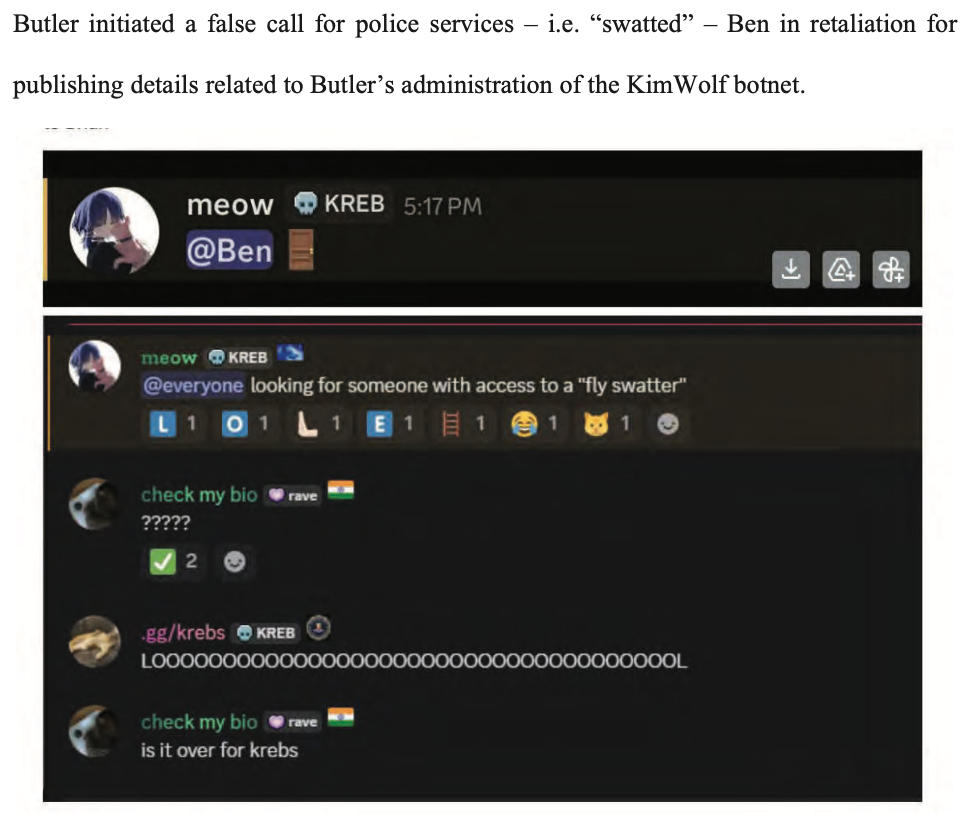
An excerpt from the criminal complaint against Butler, detailing how he ordered a swatting attack against Ben Brundage, the founder of the security firm Synthient.
The government says investigators connected Butler to the administration of the KimWolf botnet through IP address, online account information, transaction records, and online messaging application records obtained through the issuance of legal process. The criminal complaint against Butler (PDF) shows he did little to separate his real-life and cybercriminal identities (something we demonstrated in our February unmasking of Dort).
In April, the Justice Department joined authorities across Europe in seizing domain names tied to nearly four-dozen DDoS-for-hire services, although because of a bureaucratic mix-up the list of seized domains has remain sealed until today. The DOJ said at least one of those services collaborated with Butler’s Kimwolf botnet.
A statement from the Ontario Provincial Police said a search warrant was executed on March 19 at Butler’s address in Ottawa, where they seized multiple devices. As a result of that investigation, Butler was arrested and charged this week with unauthorized user of computer; possession of device to obtain unauthorized use of computer system or to commit mischief; and mischief in relation to computer data. He is scheduled to remain in custody until a hearing on May 26.
In the United States, Butler is facing one count of aiding and abetting computer intrusion. If extradited, tried and convicted in a U.S. court, Butler could face up to 10 years in prison, although that maximum sentence would likely be heavily tempered by considerations in the U.S. Sentencing Guidelines, which make allowances for mitigating factors such as youth, lack of criminal history and level of cooperation with investigators.

Yikes… Not sure what to think about this one. I expected this to happen quite quickly.
Dort claimed he lived in Hong Kong, but you don’t have to be a genius to know that he wasn’t in Hong Kong.
hello codingfire
hello Ceptea
hello, thebigyahu.
dort was at least amusing. unlike some of these clowns.
I have been battling DOS bots for months and very intensely for the past 2 weeks. It was starting to take up most of my working hours. I actually wrote a new, dynamic IP-blocker because of it this past weekend. I fail to see that any downward sentencing deviations are appropriate. To me, the volume of machines and their users victimized by this sicko makes a large UPWARD deviation in sentence appropriate. He is a digital predator of other humans. And in his personal attempts to instigate violence against journalists that could have resulted in their death, he is every bit the monster that John Dioguardi (aka Johnny Dio) was when he had acid thrown in a journalist’s face. Life imprisonment should be given serious consideration.
I agree. Swatting should be prosecuted as attempted murder. If their attacks effect US Govt infrastructure in any way they should be handled as terrorists.
yikes
“….allowances for mitigating factors such as youth, lack of criminal history and level of cooperation with investigators.”
And that is the problem! He swatted people and he will get the proverbial “slap on the wrist”.
he also did carding with dortgen
but idk if hes getting charged with that
Am not sure ‘up to ten years’ is a slap on the wrist. Though I suspect he will get at most something like 33 months in a FCI prison camp, and with good behaviour maybe a few months in an American halfway house colouring mandalas with pencils and learning what American ADLs are. Or maybe whatever Marcus Hutchinson got before they dropped his case. Dunno.
If he goes to prison, he’ll very quickly learn the meaning of “prison Bride”. He’ll also learn very quickly not to pick up bars of soap on the shower floor.
Not everybody destined to have a painful path like you had bud.
he will probably be fine. maybe seatac or something a bit more segregated. hah.
Yeah. Wait until he buys someone’s “crypto coin” and gets pardoned “as a hero.”
Krebs I kindly request that you delete this article about my Boyfriend Dort.
Keiron Ellison
Dongfeng Botnet
Keiron,
I am your biggest Phan.
Finally my competition is gone! couldn’t last without this guy uninstalling me off all the ADB
Alex Tyler
Mossad Botnet
One quickly notices the lack of authentication and curiously questions whether everyone is wise enough to know unrelated people are likely attempting to instigate wars on the lower levels of the ARP/RARP hades warscape.
Don’t worry Alex, I will be killing your bins next.
Brian Krebs
KrebNet
On conviction assign him to work for Pentagon Pete, taking notes with a #2 pencil on paper only.
Commendations, Brian, on both your digital sleuthing and reporting.
The thoughtful & purposeful way you apply your skills and diligence to such matters benefits all of us.
Thank you.
https://ottawacitizen.com/news/local-news/what-is-going-on-in-ottawa-handcuffing-of-another-child-with-autism-worries-advocates
My grandson is autistic and a computer genius. His father has been a software coder/developer for years and has his own business. Don’t know how much he learned from his father but happy he never went over to the dark side. Autism isn’t a defense, it is what actually makes him capable of doing what he does because he can see the code differently than most people. It has to do with how his brain is wired, though obviously, there are shortcomings when it comes to being intelligent enough to hide his personal information.
Eviate,
Are you suggestng that Jacob Butler is autistic?
What does that matter given that Jacob is capable of creating/running Kimwolf Botmaster?
just showing one of the many warning signs he’s shown before that this individual is a danger to others nothing more. If you read the article he threw a chair at another invidual, showing his lack of self control and critical thinking even at a young age.
more privated stuff butler doesnt want to be shown below btw.
https://www.youtube.com/watch?v=Jaj5xqmkxKc
Yikes. The video is private. Any more links to him? How do you know the handcuffed boy is him?
Danger to society maybe, but eviate lets be fr you js as problematic as dort except can’t form real social relationships so you have a gaggle of slow teenagers following you around spreading ur stuff for u. Talking about some “danger to society” from an altruistic standpoint as if you don’t do the same activity lmfao.
also him being autistic likely will lead to him getting 0 real charges in Canada for his actions which we all want to see (its been known he’s autistic he’s been doxxed before but he paid to remove it lol)
kimwolf on top sir!
finally i must say, they must have forgotten that karma always ends up catching you
i’ve met a lot of crazy absolute mentally ill people in my life but i firmly think nothing and no one will ever come close to dort and his community, i can assure you absolutely everyone hated them
rip </3
I am sick of knowing (because it is common sense, you’re kids) that people in this age group think it is alright to do things like harass and swat, because you feel you have issues with your parents after being charged. If you do things which could get yourself charged,, hope you don’t get caught, but don’t get all ‘my parents are upset’ if you do. If you do the thing, accept the consequence. Don’t punish people who didn’t do things or did other things who might have their own problems. I am not the world’s biggest proponent of ‘white hat’ (nor black hat) but this seems to be common sense.
Dortware was a paid Minecraft cheat client from around 2020–2021 — a modded version of the game that gave players unfair advantages on multiplayer servers. It was described as a powerful cheat with many features and “disablers” for anticheats on servers like Hypixel, Mineplex, and various HCF servers, developed under the handles Dort, Aidan, Newb, and Auth, and sold through their Discord for around $17.50 in crypto. It was marketed as having strong anti-cheat bypasses (including disabling Hypixel’s “Watchdog”) plus the usual combat, movement, render, and exploit features designed to let players cheat without getting detected and banned, and like most paid clients it was eventually cracked and leaked for free. One caveat: I can’t confirm the “Dort” behind Dortware is the same Jacob Butler from the KimWolf botnet case — the alias is common and nothing in the court filings or news coverage links the two, so treat that connection as unverified